Writing the Perfect Beast #27
There are no winners when xenophobia becomes more damaging than criticism...

Starting in October 2005, I decided to talk honestly about the business of how I write poetry. There are people who teach how to create poetry, how to format it, how to submit and how publishing in general works. I am not seeing that many people doing work on what you need to do with your brain and mental attitudes to make that stick, grow and then evolve. HI THERE.
Let’s see if we can change that.
This was not the post I intended to write today, but on considered reflection it is the post that needed to be written.
 The Friday Poem
We start this discussion with someone else's feedback. Victoria Moul is a British literary critic, scholar, poet and translator living in Paris. Hilary Menos has been published by Seren and Smith|Doorstop, and has been a poet since 2005: between them they have pretty comprehensively savaged the text of the National Contest's winning entry. Menos is The Friday Poem's editor.
However, I didn't come across this as I do not read the Substack. In fact, I have this publication on my personal blacklist, over an incident that took place back in the day when Twitter was not an overt right-wing mouthpiece, but the signs were there. The friend who alerted me to this text started a thought process that I was quite a long way down, until I went back to read the article again for quotes.
The opening paragraph, the space where I should be convinced this work has merit, and that I should buy into it's point, reads as follows:
So, the dust has started to settle on this year’s National Poetry Competition winners announcement. We’ve all read the winning poem, ‘The Gathering’ by Partridge Boswell, of Vermont, and the second placed poem, ‘Axe’, by Damen O’Brien, from Queensland, Australia, and the third placed poem, ‘Badminton’, by Zoe Dorado, from California, and we’ve all muttered something about how none of the top three are British, as far as we can tell, or living in Britain, so why is the competition called the National rather than the Open or the International? Then we’ve gone back and really looked at the winning poem again, and … well.
Well, indeed. I didn't mutter ANYTHING about the nationalities of the winning authors. I CERTAINLY gave absolutely zero thought to that even being a factor. Suddenly, the grace and favour I was prepared to give to this 'close' reading by a poet and a literary critic has also been effectively eviscerated. I'm not taking people seriously who judge work in Paragraph One as 'not British'.
I've had a lot of issue in the last few months with my work 'not being a good fit' for all number of different spaces, but that's the point. ANYTHING can be a poem: ‘Good’ then becomes a subjective benchmark and ‘Award Winning’ becomes divisive. In all the spaces in between are the people who could do with learning (who rarely do) with those who are easily hurt being further damaged.
My work won't work in many spaces because these people want something else.
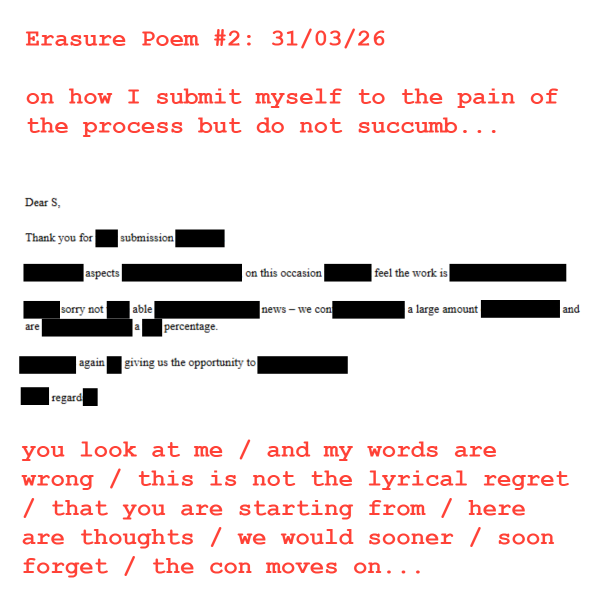
This is a crucial point when learning from failure. If your criticism from anything stems from a misplaced idea that you are somehow better than everyone else, it is time to check your privilege. Just because you have a platform that allows you to show how bad something is based on your reading of it, and to show how clever and capable you are of doing so, does not mean that you should.
I'd love to ask people straight up why I fail at shit, I really would, but it doesn't happen, it never will happen and I'd be foolish to argue that 90% of the time. However, what I can do is if I'm treated like dirt by a publisher and they effective belittle both my work and my vision, is take what I wrote and leave. That's what I did last year with Hedgehog Press, and I'll be happy to do it again if required.
There are no winners when xenophobia becomes more damaging than criticism.

I sent a poem to another friend of mine this week. I wasn't clear at the time of my intent by the action. They saw something in it that I've known about for a while, but have not yet fully embraced as a direction: all I was looking for was validation. It turns out that poem is an experiment on what exactly is possible right now. Can I get myself published opening a poem with a controversial subject line?


It turns out that I can. This poem sits in incredibly illustrious company on the website owned by a former Forward Prize winning poet. It's title is a location created by https://what3words.com which has become a new form of sedition, as it turns out a really smart way of hiding intent in plain sight. I can't talk about the project right now either as the pamphlet it comes from is in contest.
Sometimes, if you want to make as point, how you present yourself really matters. However smart you are, or capable, or accurate the work ends up being, if it's not backed up by fairness and care, it will cause more harm than good. People will tell you that the REAL problem is having too much politics in poetry, and I'll tell them that's simply not true. The problem is teaching people how to be tolerant.
Poetry is for EVERYBODY, regardless of what you personally believe.