The Numbers Game #2
This post has the potential to go one of two ways…

or, I have to be organised, why can’t they be?
I tried, largely unsuccessfully yesterday, to put thoughts about the process of judging things into words that did not make me sound like I was aggrieved. This is not about being mean to other people, because you should NEVER do that. Judging, in this context, refers exclusively to deciding the outcome of poetry competitions, especially large ones.
At least one of my social media mutuals has done their best in the past to demystify this state of affairs, with varying degrees of success. Occasionally, someone will (intentionally or otherwise) open the door to a particular process just wide enough for those paying attention to be able to see further into a contest than maybe the organisers might have intended.
I think that happened yesterday from a genuinely (for me) surprising source.
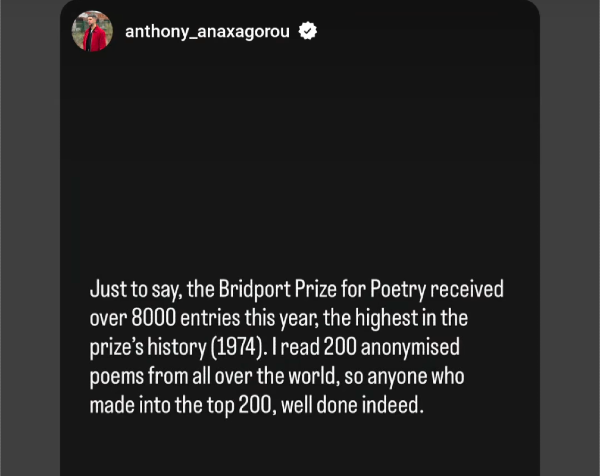
So, the head of OutSpoken Press did NOT judge all the poems? I know other poets who have judged lesser contests by carrying the entire pile of entries around with them, reducing that pile over time. They were, of course, not nearly as entered as Bridport. 200 is still a sizeable load when all is said and done, but there‘s a Black Hole of Uncertainty which covers 7, 800 other pieces.
That number of entries also allows us to work out how much money Bridport made from the contest this year, which I’ll allow you the opportunity to sit with and consider quietly for yourself. I’m not here to do sums, I’m far more curious about The Sifting Process. It’s something that rarely, if at all gets spoken about. The last time that happened publicly as I recall came from The Poetry Society.
Your work may be ‘read’ by several people before it even sees a ‘judge’.

There are a quiet army of poets who (I would assume) are being paid to sift major contests, quietly eliminating the vast majority of entries so that the ’longlist’ is a manageable number. If I had 800 entries for a contest, I’d probably longlist 100 poems from that pile. 200 from 8000 is actually a conservative number in my head as a result, but it will have been hard work, undoubtedly.
I have absolutely no doubt that Mr Anaxagorou will have done a superlative judging job. My curiousity (and that is what this is) has focused on what the sifters will have been told to look for as a Longlist Poem. I suspect it is not even specific stuff, but would go on knowing in your own head what makes a decent piece of poetry. That in itself however is a ridiculously broad church of tastes.
It leaves 7800 pieces of work with no clear indicator of why they did not succeed.

As I consider myself as a working-class poet, it is a continuing source of concern that, standing in certain spaces in my industry, education is a barrier to entry. Having done the maths on what it would take to do an MA in Poetry, and knowing that the money simply does not exist to do so, I will occasionally find myself wishing I had made different decisions back in my 20’s.
There is no changing my past, only the reorganising of the present to ensure that going forward, anything I do that involves the discussion of my own work is conducted as transparently as possible. It is why I am leaning into the teaching of others next year, in the hope that some of the (often intentional) gatekeeping that takes place in the poetry world can be both exposed and bypassed.
Even if I cannot progress further forward from this point, I can help others try.

Winning things has become a really fraught process for me, and I still struggle to make sense of how what I know is the absolute best I am capable of is still not enough to excite certain people with the Keys to the Publishing Bus. This year has bought home to me, more than any other, what a poisoned chalice success has the potential to be. Those thoughts are now, I know, beginning to settle properly.
I would dearly love more transparency in poetry publication, and especially around contests. It’s why I have started Ways of Seeing to do exactly that, at every stage, with plans in place should the format become more popular. However, what I’d really like more of is for organisations to make good on promises and respect their own processes. Tell more people why they did not get Longlisted.
Use your entry fees to better educate the people who provided them.