WoS #1: Yellow Jug Longlist
We have a Longlist, and we have some observations as we enter the next stage of the process...

After the call, we begin to demonstrate the method...
When I started this project rolling in my head, there was one REALLY important aim in mind. As someone who has often suffered when faced with being rejected by magazines, journals AND publishers, I have often wondered whether it would be possible to foster creativity and progress in poetry contests and not make it as painful on the heart as that sequence of events often ends up becoming.
I absolutely get that failure is part of the process, and without it you may never find the true creative breakthroughs required to deepen the complexity of your craft. On the other side of the coin, there's a lot of work that could be done to give back a lot more than currently is offered. I'm not naming names, but one particular version of 'well-meaning feedback' from a publisher this year was anything but.
This is me, now attempting to be an adult about the whole progress.
The biggest issue ultimately in 'judging' ANYTHING AT ALL is that what you see as engaging and how that makes you feel can often be two completely different beasts. Being hyper-aware of this, we are going into Ways of Seeing with some VERY clearly defined pathways. We'll also be explaining each decision at EVERY STEP of the process.
I don't think I've been fair to anyone whose entered if I don't allow everybody a wee peek behind what is a very specifically-constructed curtain. Rules and instructions here are what I hope to use to highlight mistakes I made in my early days of submitting (and which, I'll be honest, can still happen). There's also a real determination to share this process to ANYONE who is interested.
These posts are for you, whether you chose to take part this time or not.
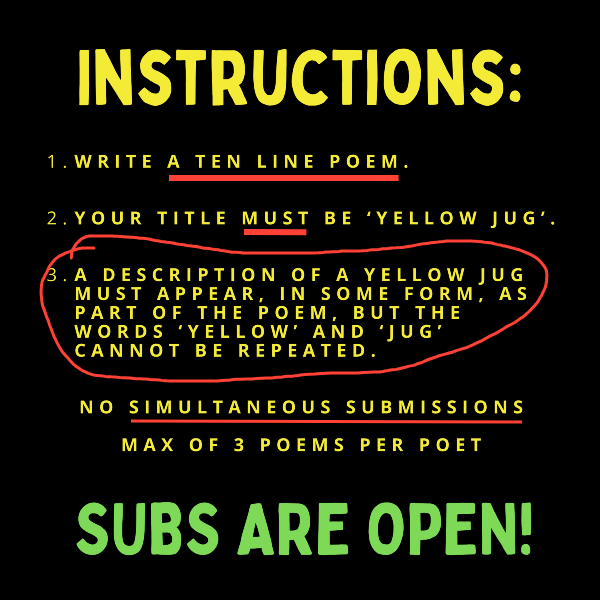
The people who don't make it to the Longlist got an email yesterday. In it I explained (in some detail) what it was that was responsible for their exit from the process. The Rules above will be different in every experiment, but they will always hinge on making sure you have read everything carefully:
- There will ALWAYS be an instruction related to form. I might (for instance) ask for 10 lines as a single line, four two-line stanzas and a single line end.
- There will be an instruction involving the name of your poem, which will then directly relate to the final instruction. The final instruction is very much intended to put you in tension with the rest of the instructions ^^
- I am HUGELY KEEN not to have people submit previously-written work. This is being fashioned as a 'write to a brief' exercise.
What Happens Next?
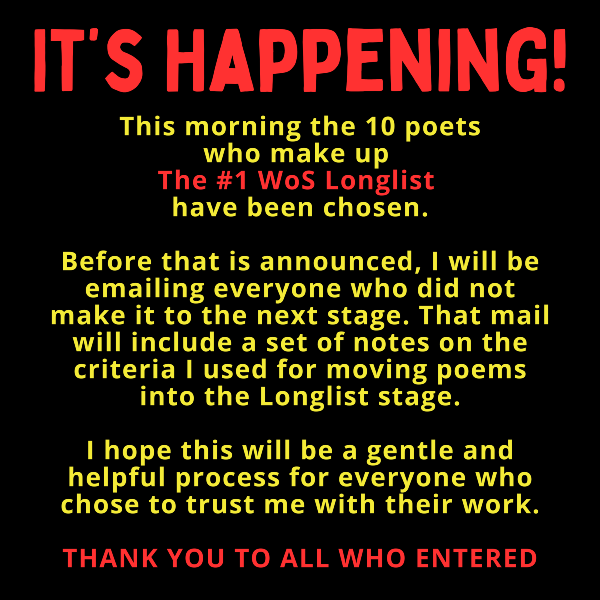
The Longlist (which is ten poems from ten poets) appears on the 15th. The Shortlist will follow on the 22nd. The successful poems (one 'Winner' and two 'Highly Commended' poems) will be published here on November 1st, with an accompanying set of notes which will explain as simply as possible why the work was chosen, plus how I feel the poets succeeded at completing this brief.
You then have a month to work out whether you fancy a go at Experiment #2, which opens for submissions on December 15th. By then the prize pot will have rolled up to £30, and we start the process again. Until then, I'm going to share the notes I sent to all those people who did not proceed to Stage 2. That process has also produced an unexpected result, which we'll discuss further on the 15th.

Of those who are not proceeding further, the work remains of an impressive quality.
However: a number of poets did not, on this occasion, consider The Instructions they were given. The Instructions will remain a KEY component to this process, and in many ways these hold equal importance to the poetry. This means, in practical terms:
certain poems were not 10 lines long.
An amendment to the Experiment #2 contest rules will now ensure that this is made clearer.
the words ‘yellow’ and ‘jug’ appeared in the poem itself.
the poem was not entitled ‘Yellow Jug’.
Of the poems that passed what will always be an intentional first hurdle in every subsequent submission window, there were also two key factors which came into play:
Certain poems were either overly descriptive or overly reflective and did not feel as if the sides of this process were holding the finished pieces correctly ‘in tension’.
There was no clear indication of why the poet had chosen ‘their version’ of the jug to describe.
These secondary considerations were not clearly specified anywhere. They are part of what I look for personally in specific pieces of work that I find enjoyable. The argument of whether that makes ‘good poetry’ or not is something I intend to explore using long-form work over the next year. The point of placing them here is twofold:
1. Poetry is a medium of communication. It can be esoteric, and basic, and every single point in between. Ten lines does not give you much space in which to build anything, but as will become apparent as we progress from Shortlist to successful poems, you can also do an awful lot with ten lines if you are able to balance the requirements that communication demands of the poet.
2. Poetry is an emotional process. This one will cause some banter, I suspect, as time moves on. For me an emotional core allows me something I can associate with on multiple levels. It also means that I don’t have to immediately connect with the descriptive process on offer to resonate with the intellectual component of the work.
Future submissions will play in this second point using The Instructions.
You have been warned.